Expanding a business internationally is rarely just a matter of translating a website or running ads in different languages. True localization goes deeper—it affects branding, trust, user perception, and even how easily customers can find and remember you. One of the most underestimated factors in this process is the domain name itself.
While companies often focus on logistics, pricing, and marketing strategy, the choice of domain name and top-level domain (TLD) can quietly determine whether a brand feels native to a market or foreign and untrusted.
Why your domain is more than a web address
A domain name is often the first interaction a customer has with your brand. Before they see your product, pricing, or content, they see your URL in search results, ads, or social media bios. That single line of text sets expectations.
A strong domain strategy can:
Build immediate trust
Users tend to associate familiar TLDs with legitimacy. Extensions like .com or .org are globally recognized and often perceived as “safe defaults.” Meanwhile, industry-specific TLDs such as .ai, .tech, or .global can signal innovation or scale, especially in digital-first industries.
Improve memorability and click-through rates
Short, clean, and predictable domain structures are easier to remember and type. When users don’t have to think twice about spelling or extension, friction decreases and engagement improves.
Support international expansion
A domain strategy that anticipates global growth avoids fragmentation later. Brands that plan early can avoid expensive migrations or inconsistent naming structures across regions.
Local vs global domain strategies
One of the core decisions in international branding is whether to use a global domain strategy, a local one, or a hybrid approach.
Global domains (generic TLDs)
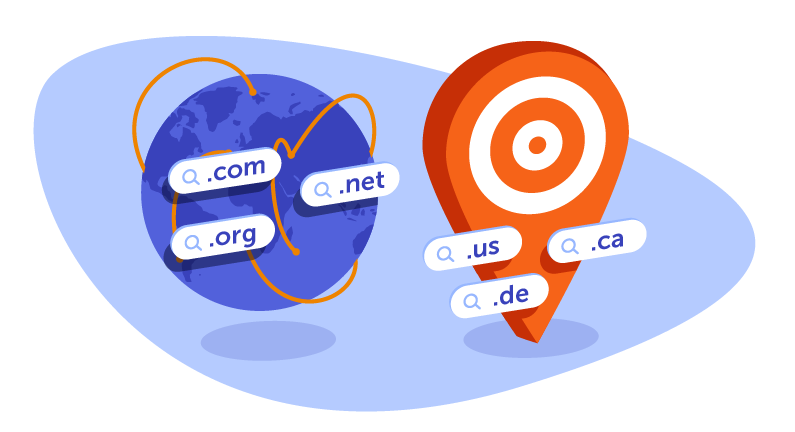
Global TLDs like .com, .net, and .org remain the dominant standard for international brands. They signal neutrality and scale, making them ideal for companies that want a unified identity across markets.
More modern extensions such as .ai, .io, and .tech are often associated with startups and technology-focused companies. While they don’t inherently provide geographic trust signals, they can strengthen brand positioning in niche industries.
Advantages of global domains:
- Consistent branding worldwide
- Easier marketing and recognition
- No need to manage multiple websites
- Strong baseline trust in most markets
Limitations:
- Less local relevance
- Can feel “foreign” in markets with strong national identity
Local domains (ccTLDs)
Country-code top-level domains like .uk, .de, .fr, or .ca signal that a business is locally present or locally focused. In many regions, this perception significantly impacts conversion rates.
For example, users in Germany often show strong preference for .de websites, while in the Netherlands .nl domains dominate consumer trust.
Advantages of local domains:
- Strong local trust signals
- Better alignment with regional identity
- Potential SEO benefits in country-specific search results
- Higher perceived accountability
Limitations:
- Requires managing multiple domains and websites
- Increased operational complexity
- Fragmented branding if not handled carefully
The role of hybrid domain strategies
Many global companies adopt a hybrid approach:
- A primary global domain (usually .com)
- Country-specific domains for key markets
- Regional landing pages or subdirectories
For example:
- brand.com (global hub)
- brand.de (Germany)
- brand.fr (France)
This structure balances consistency with localization, allowing brands to maintain a unified identity while adapting to regional expectations.
Domain structure and SEO impact
Domain choice also influences search visibility in subtle but important ways.
Search engines consider:
- Geographic relevance of ccTLDs
- User trust signals (click-through rates and bounce rates)
- Keyword relevance in domain names (to a limited extent)
- Site structure consistency
A ccTLD like .fr may rank more easily in France for local queries, while a .com domain might require stronger SEO signals to compete locally.
However, SEO benefits are not purely technical—they are behavioral. Users are more likely to click on domains they recognize or trust, and those engagement signals indirectly improve rankings.
International Domain Names (IDNs) and language localization
International Domain Names (IDNs) allow domain registration in non-Latin scripts such as Arabic, Cyrillic, or Chinese. These domains can significantly improve accessibility in native-language markets.
Benefits include:
- Improved readability for local users
- Stronger cultural alignment
- Increased trust in non-English markets
- Better brand recall in native scripts
However, IDNs also introduce complexity in marketing, technical infrastructure, and cross-market consistency.
Risks of poor domain localization decisions
Choosing the wrong domain strategy can actively damage expansion efforts.
Common issues include:
Cultural misalignment
A domain or brand name may carry unintended meanings in another language, potentially harming reputation or causing confusion.
Trust gaps
In some markets, users are hesitant to engage with unfamiliar TLDs, especially if local alternatives exist.
Fragmented brand identity
Managing multiple inconsistent domains can weaken recognition and dilute marketing effectiveness.
Missed defensive protection
Without securing key ccTLDs early, competitors or third parties may register them, forcing costly acquisitions later.
Strategic principles for global domain planning

A strong domain strategy is not about choosing a single “best” extension—it’s about aligning structure with business goals.
1. Start with a primary global identity
Most international brands benefit from securing a clean .com or equivalent global domain as their core hub. This becomes the foundation of all branding efforts.
2. Reserve key local domains early
Even if not immediately used, securing relevant country domains protects brand identity and prevents misuse.
3. Keep naming simple and scalable
Short, brandable domains consistently outperform complex or keyword-heavy alternatives in memorability and trust.
4. Align domains with market behavior
Markets differ. Some prioritize global brands; others prefer local presence. Your domain strategy should reflect that reality rather than override it.
5. Think long-term, not just launch-stage
Domain decisions made early can become costly constraints later. Treat them as infrastructure, not decoration.
Final perspective
Localization is often treated as a content or marketing problem, but in reality it starts at the foundation of digital identity. The domain name is not just a technical requirement—it is a trust signal, a branding tool, and a strategic asset.
Brands that understand this early tend to scale more smoothly across borders. Those that don’t often discover, too late, that their biggest barrier to entry wasn’t their product—but how they presented themselves online.
A strong domain strategy doesn’t guarantee global success, but a weak one can quietly block it before it begins.